Key Takeaways
- A dental bridge and a dental implant both replace missing teeth, but a bridge depends on the teeth beside the gap while an implant stands on its own in the jawbone.
- A traditional bridge means reshaping the healthy neighbor teeth. An implant leaves them alone and helps keep the jawbone from shrinking.
- A bridge is faster to complete, while an implant takes a few months of healing but can last for decades with good care.
- Cost depends on how many teeth you replace, the material, and whether you need extra steps like a bone graft. Your exact cost comes at a consultation.
- J. Ladd Williams Cosmetic Dentistry in Mesa, AZ places both, so you get a straight answer about which one fits your mouth.
If you are missing a tooth, the two fixed options are a dental bridge and a dental implant. An implant is usually the better long-term choice when your jawbone is healthy and the teeth beside the gap are in good shape. A bridge can be the better fit when those neighbor teeth already need crowns, or when you want the job done in weeks instead of months.
At J. Ladd Williams Cosmetic Dentistry in Mesa, Arizona, Dr. Williams has restored smiles since 1994 and has placed thousands of implants. He also places bridges. This guide walks through how each one works, what each costs you over time, and how to tell which one suits your mouth.
How a dental bridge works
A dental bridge fills a gap with a replacement tooth, called a pontic, which is held in place by crowns on the teeth at each end of the gap. The whole restoration is cemented, so you never take it out at night.
To make room for those crowns, the dentist has to reshape the neighboring teeth by removing some enamel, and that step is permanent. If those teeth already have large fillings or need crowns anyway, little is lost. If they are healthy and untouched, it is a real sacrifice.
There are a few kinds of bridges:
- Traditional bridge. Crowns on both sides of the gap. This is the most common type.
- Cantilever bridge. A crown on one side only, used when there is a supporting tooth on just one side. It is not as strong as a traditional bridge.
- Maryland bridge. Small wings bond to the backs of the neighboring teeth. It is mostly used for front teeth, since it cannot handle heavy chewing pressure.
A bridge usually takes two visits a few weeks apart. You wear a temporary bridge while the lab makes the final one. Learn more about the crowns that hold a bridge on the dental crowns page.
How a dental implant works
A dental implant replaces the root as well as the visible tooth. A small titanium post is placed in the jawbone, and over a few months the bone grows around it and locks it in place. Then a custom crown is attached on top.
Because the implant stands on its own, the neighboring teeth are never touched, and you brush and floss it much like a natural tooth.
An implant also does something a bridge cannot. When a tooth is lost, the bone that held its root gradually starts to shrink. A bridge sits on top of the gum, so the bone under the replacement tooth keeps shrinking over time. An implant sits inside the bone and helps preserve it, which can affect how your face and gums look years from now.
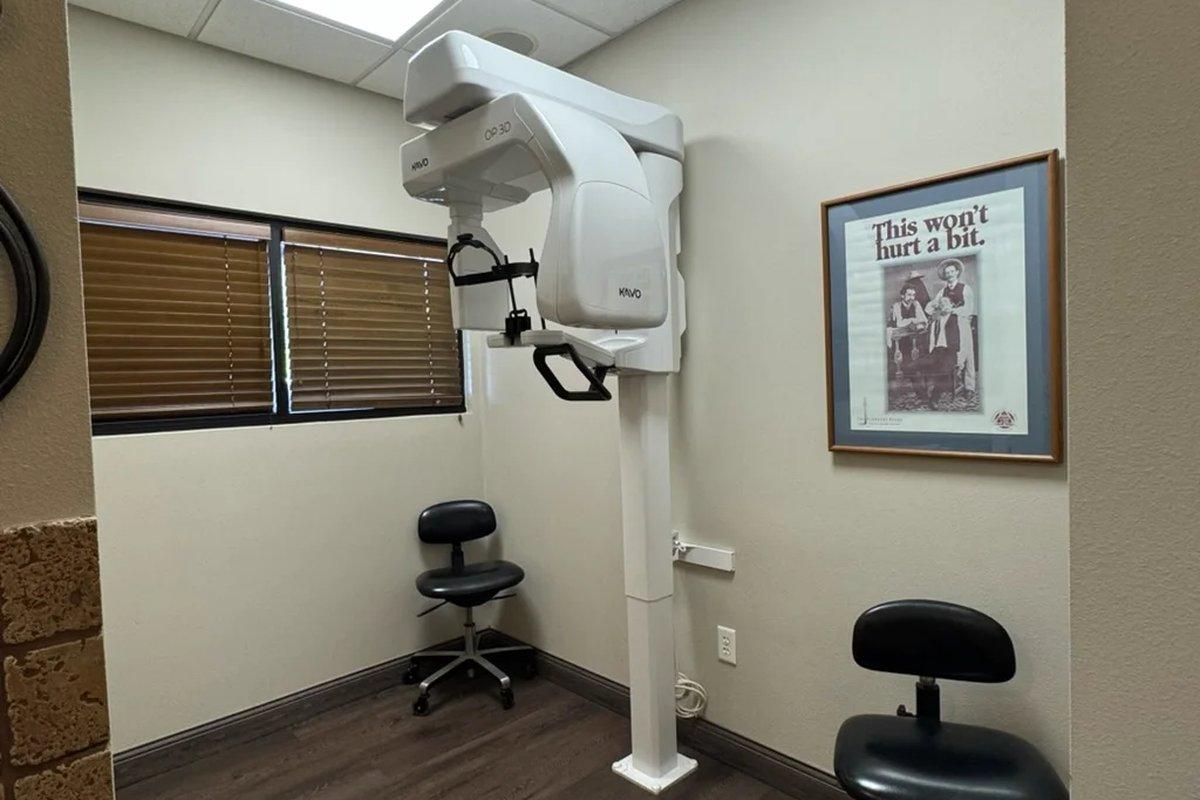
Before any implant, the office takes a 3D scan with its in-office KaVo OP 3D cone beam scanner. The scan shows how much bone is available and exactly where the nerves and sinuses are located. See the full process on the dental implants page.
The middle option: an implant-supported bridge
When three or more teeth in a row are missing, you do not always need a separate implant for each one. An implant-supported bridge rests on two implants, one at each end, with replacement teeth in between. This is a common solution when someone asks about a 4-tooth or 6-tooth bridge.
You get the stability of implants without reshaping any natural teeth, and it takes fewer implants than replacing every tooth individually. The trade-off is time, because the implants need to heal before the final bridge is attached.
If most or all of your teeth are failing, a full-arch option may make more sense. The post Dental Implants vs. Dentures in Mesa compares those choices.
Bridge vs. implant side by side
| Feature | Traditional bridge | Dental implant |
|---|---|---|
| Neighbor teeth | Reshaped for crowns | Left alone |
| Jawbone | Can keep shrinking under the false tooth | Helps preserve it |
| Surgery | None | Minor surgery to place the post |
| Time to finish | A few weeks | A few months |
| Typical lifespan | Often 5 to 15 years, sometimes longer | Post can last for decades; the crown may need replacing |
| Cleaning | Floss threader or water flosser under the false tooth | Brush and floss like a natural tooth |
How long does each one last?
Cleveland Clinic puts the average life of a dental bridge at 5 to 15 years, with some lasting longer. Bridges often fail because of decay or gum problems in the supporting teeth rather than because the bridge itself breaks, which is why daily cleaning under a bridge is so important.
The implant post itself can last a lifetime with good care, although the crown on top wears like any crown and may eventually need replacing. A large review of published studies found that about 96% of single implant crowns were still functioning after five years.
Bridges on healthy teeth can perform very well too. One study that followed 3-tooth bridges for about ten years found that all of the bridges on natural teeth were still in use, and a history of gum disease was the biggest risk factor. The health of your gums and neighboring teeth matters as much as the choice itself.
Who is a better fit for which?
An implant may suit you if:
- The teeth next to the gap are healthy and have no crowns.
- You have enough jawbone, or are open to a bone graft to build it up.
- You want the option most likely to last for decades.
- You are in good general health. Smoking and uncontrolled diabetes can slow healing.
A bridge may suit you if:
- The neighbor teeth already have large fillings or need crowns.
- You want to avoid surgery, or a health condition makes surgery a poor idea.
- You need the gap filled in weeks, not months.
- Bone loss would make an implant hard to place without major grafting.
What affects the cost of a bridge or an implant?
People often search for "bridge for teeth cost" or "dental implant cost" and find numbers all over the map, because no two cases are the same. These are the factors that change the cost:
- How many teeth. A 3-tooth bridge, a 6-tooth bridge, and a single implant are very different jobs.
- Material. Zirconia, all-ceramic, and porcelain-fused-to-metal restorations each cost a different amount to fabricate.
- Extra steps. An extraction, a bone graft, or treating gum disease first adds to the plan.
- Planning. A 3D scan and careful planning are part of every implant case.
- Insurance. Many plans cover part of a bridge. Implant coverage varies a lot from plan to plan.
Consider the cost over time, too. An implant often costs more at the start, while a bridge may need replacement once or twice over a lifetime, and the supporting teeth can need treatment of their own.
J. Ladd Williams Cosmetic Dentistry does not quote prices online, since an accurate estimate depends on your scan and examination. You will receive an exact cost at your consultation. The office also offers financing options to spread out payments. For more on implant planning and cost, see Dental Implants in Mesa, AZ.
How to decide
Start with the teeth next to the gap. If they are healthy, an implant protects them, and if they already need crowns, a bridge puts that work to good use.
Then look at the bone, since the 3D scan shows whether there is enough for an implant or whether a graft would be needed first.
In Dr. Williams' experience, an implant is usually the better choice when the teeth beside the gap are healthy. A bridge needs those teeth shaved down to hold crowns, and as he puts it, "It is usually not recommended to shave down a perfectly good tooth." He is clear that bridges do work, but they are "more aggressive to the surrounding teeth," and he calls them "1950s technology." Implants, he says, "add strength to the area, maintain bone and preserve the natural teeth surrounding them."
Last, think about your timeline and health. Some patients need a fixed tooth before an important event or simply prefer to avoid surgery, while others are planning for the next 20 years. Both are reasonable priorities, and Dr. Williams will walk through the trade-offs with you before anything is decided.
Schedule a Consultation in Mesa, AZ
If you are weighing a bridge against an implant, a scan and an exam will answer the question for your mouth. Call J. Ladd Williams Cosmetic Dentistry at (480) 964-9020 to schedule a consultation, or visit our contact page to request an appointment online.
The office is located at 1244 N. Greenfield Rd., Ste. 103, Mesa, AZ 85205, and the practice welcomes patients from Mesa, Scottsdale, Phoenix, Gilbert, Chandler, and across the East Valley.
Frequently Asked Questions
Is a bridge or an implant better for one missing tooth?
For one missing tooth with healthy teeth on both sides, an implant is usually the better long-term choice. It leaves the neighbor teeth alone and helps keep the jawbone from shrinking. A bridge can make more sense if those neighbor teeth already need crowns.
How long does a dental bridge last compared to an implant?
A dental bridge often lasts 5 to 15 years, and some last longer. An implant post can last a lifetime with good care, though the crown on top may need replacing someday. Daily cleaning and regular checkups help both last longer.
What affects the cost of a 6-tooth bridge or a dental implant?
The number of teeth, the material, and any extra steps like extractions or bone grafts all affect the cost. Insurance may cover part of a bridge, while implant coverage varies by plan. J. Ladd Williams Cosmetic Dentistry gives an exact cost at a consultation and offers financing options.
Is a zirconia bridge a good choice?
Zirconia is strong and tooth-colored, so it works well for many bridges. Research shows layered zirconia can chip more often than metal-ceramic bridges. The right material depends on where the bridge sits, how hard you bite, and how it needs to look.
Can I get an implant years after losing a tooth?
Often, yes. The jawbone shrinks after a tooth is lost, so there may be less bone to work with. A 3D scan shows how much bone is left, and a bone graft can rebuild it if needed.
Sources
- American Dental Association, MouthHealthy: Bridges
- American Dental Association, MouthHealthy: Dental Implants
- Cleveland Clinic: Dental Bridges
- Cleveland Clinic: Dental Implants
- Muddugangadhar BC, et al. Meta-analysis of Failure and Survival Rate of Implant-supported Single Crowns, Fixed Partial Denture, and Implant Tooth-supported Prostheses. J Int Oral Health, 2015.
- Cristea I, et al. Oral and Periodontal Risk Factors of Prosthetic Success for 3-Unit Natural Tooth-Supported Bridges versus Implant-Supported Fixed Dental Prostheses. Diagnostics, 2023.
- Harrach S, Bouabid M. Influence of Prosthetic Material Type on the Survival of Tooth-Supported Fixed Dental Prostheses: A Systematic Review. Clin Cosmet Investig Dent, 2026.
- Ucer C, Khan RS. Extraction Socket Augmentation with Autologous Platelet-Rich Fibrin (PRF): The Rationale for Socket Augmentation. Dent J, 2023.